 ALERT
ALERT
JBL Live Buds 3 vs Sony WH-H910N
Advertisement
| Specification | ||
|---|---|---|
| Price | Rs.24,999.00 |
Rs.24,990.00 |
| Brand | JBL |
Sony |
| Model No | Live Buds 3 |
WH-H910N |
| Wired / Wireless | Wireless Headphone Specification |
Wireless Headphone Specification |
| Headphone Type | In Ear Canal |
Over Ear |
| Magnet Type | Dynamic |
Neodymium |
| Driver Diameter | 10 mm |
25 mm |
| Impedance | 16 Ohms |
17 ohm |
| Sensitivity | 103dB SPL@1 kHz |
100 dB/mW |
| Frequency Response | 20 Hz - 40KHz |
5 Hz - 40,000 Hz |
| Maximum Power Input | 5V 1A |
5 V DC |
| Wireless / Bluetooth Details | ||
| Wireless Technology | Bluetooth |
Bluetooth |
| Bluetooth Version | 5.3 |
5.0 |
| Compatible Profiles | All Bluetooth Devices |
All Bluetooth Devices |
| Supported Codecs | AAC, SBC |
A2DP, AVRCP, HFP, HSP, LDAC, AAC, SBC |
| Battery Type | Lithium-Ion Batteries |
lithium-ion |
| Bluetooth Range | 10 Meters |
10 Meters Class 1 |
| Battery Life | 10 Hours |
35 Hours |
| Charging Time | 2 Hours |
5 Hours |
| Noise Cancelling | True Adaptive Noise Cancelling |
Digital |
| Available Colors | Black, Blue, Purple, Silver |
Black, Red, Orange |
| Connector Plating | NA |
Stereo 3.5 mm |
| Cable | USB Type-C Charging Cable |
USB C-Type Cable |
| Weight | 73 GM |
251 gm |
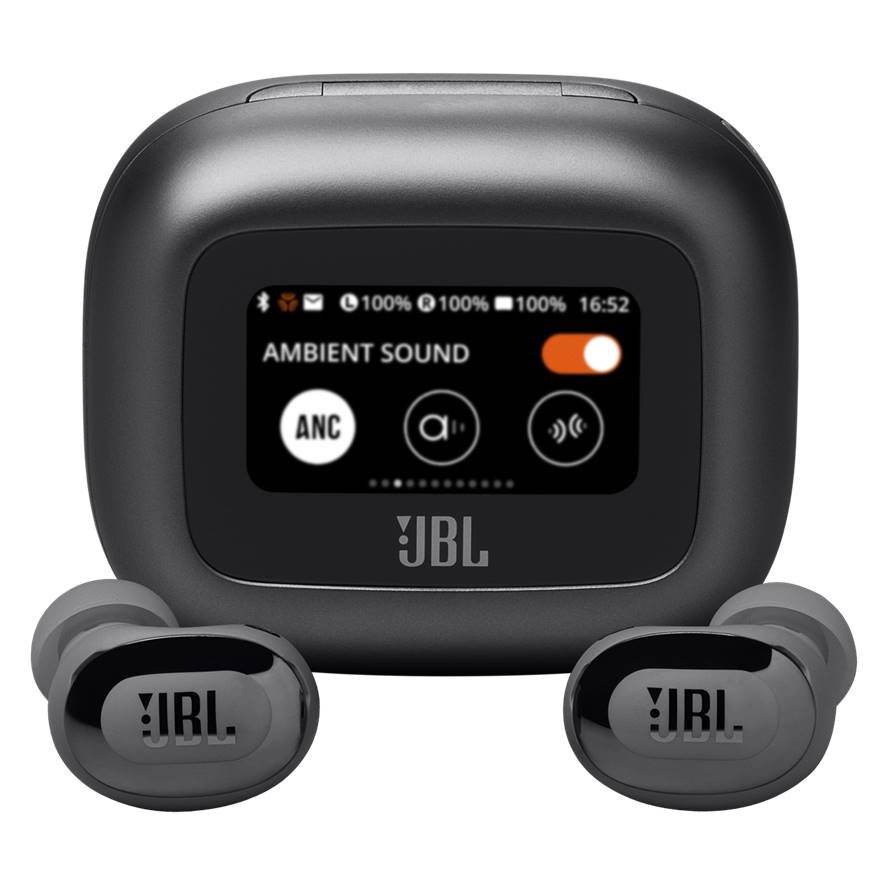
| Other Features | IP55 Water and dust resistant. 40 Hours Total Playback : Enjoy 10 hours of playtime, plus another 30 in the charging case.* Need to recharge faster? 10 minutes on a USB type-C charging cable will give you another four hours of playtime. True Adaptive Noise Cancelling With Custom Control : Tune out the outside world entirely or customize just how much ambient sound you decide to let in, with four noise-sensing mics that automatically adapt to your surroundings in real time. Hi-Res Audio Wireless With JBL Signature Sound : The JBL Live Buds 3’s 10mm dynamic drivers are powered by JBL Signature Sound. Each driver is perfectly tuned to deliver deep bass, balanced mid-range, and refined high frequencies—all at any volume level. 6 Mics For Perfect Calls You Can Customize Yourself : Six beamforming microphones reduce wind and noise interference, so your words always come through loud and clear. A voice equalizer and voice level optimizer give you full control not only over how you sound to others. Convenient Smart Charging Case For App-Free Control : You can customize every aspect of your JBL Live Buds 3 earbuds with the 1.45-inch touchscreen display on your Smart Charging Case. The display gives you full control of your sound on any devices - laptop, TV, smartphones, or tablets. |
High-Resolution Audio compatible. Digital noise cancelling and ambient sound mode let you control what you hear. High-quality wireless audio with Bluetooth® wireless technology and LDAC™. Slim, light and comfortable for all-day listening. Fine-tune your sound using the Sony, Headphones Connect app. Gold-plated L-shaped stereo mini plug. Dual Noise Sensor technology. Adaptive Sound Control automatically adjusts to whatever you do. Slim and sleek for total comfort. All day power and quick charging (10 min = 2.5 hr). Just say the word with Voice Assistant. Fine-tune settings from your phone. Enjoy the subtle nuances of studio-quality sound in higher-than-CD quality with High-Resolution Audio. |

Advertisement
Compare JBL Live Buds 3 with:
Compare Sony WH-H910N with:
Top Differences
- Battery Life: 35 Hours vs 10 Hours
- Noise Cancelling: Digital vs True Adaptive Noise Cancelling
- Driver Size: 25 mm vs 10 mm
- Bluetooth: 5.0 vs 5.3
- Weight: 251 gm vs 73 GM
Advertisement